The Mac mini used to be the obvious answer to "I want a small desktop." In 2026 it is a much harder sell.
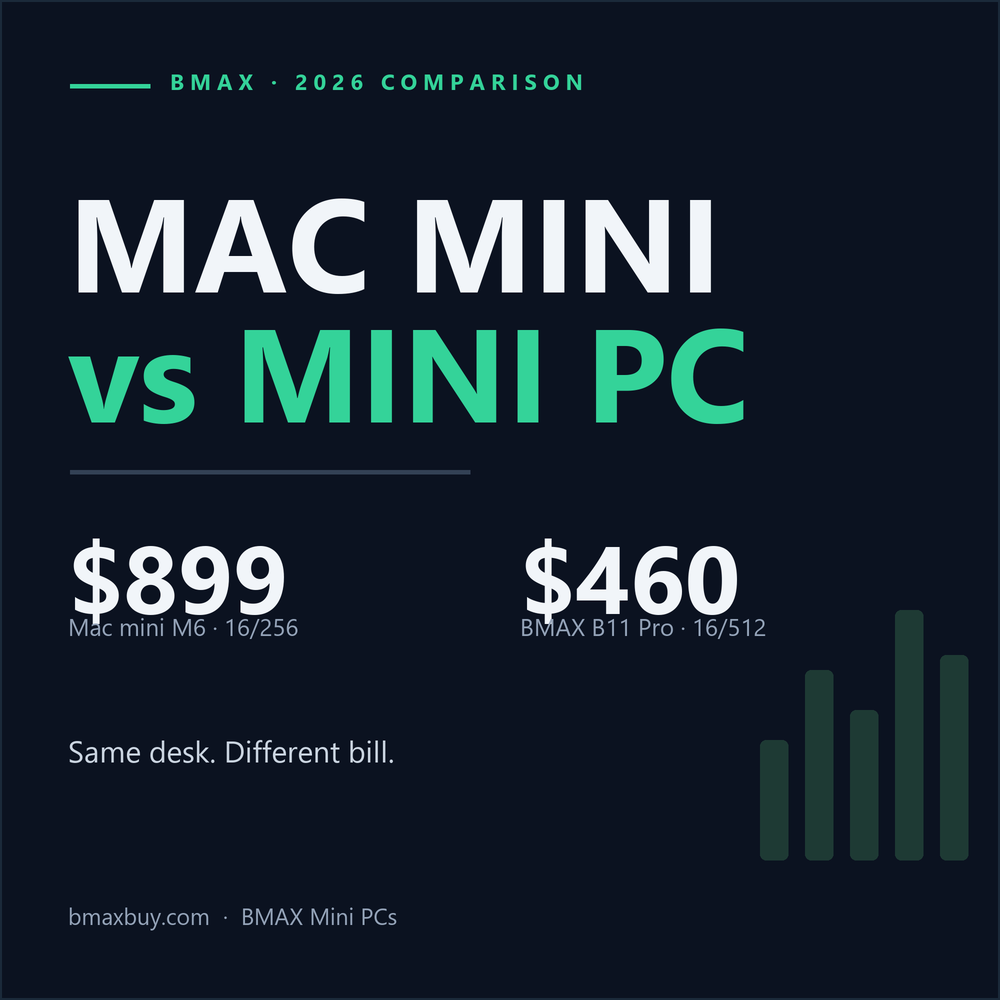
Apple's new Mac mini with the M6 chip starts at $899 for 16GB of memory and 256GB of storage. That is $300 more than the M4 model's $599 launch price two years ago, and this generation's storage is soldered to the logic board — no aftermarket SSD, ever.
Meanwhile a Windows mini PC with more memory, four times the storage, and a replaceable drive sells for $749.99. So the question is no longer "which is smaller" — both are the size of a book. It is what the extra $150–$440 actually buys you.
Key takeaways
- The Mac mini M6 starts at $899 (16GB / 256GB), up from $599 at the M4's launch.
- A BMAX B12 Power gives you 24GB / 1TB for $749.99 — $149 less, with a replaceable M.2 drive.
- Neither machine has upgradeable memory. Both use soldered LPDDR5 / unified memory.
- Five-year cost: $942 for the Mac mini, $824 for the B12, $513 for the B11 Pro.
- The Mac still wins on single-core speed, power draw, macOS and resale value. It loses on price per gigabyte, repairability and Windows software.
In this guide
What changed in 2026
Three things happened to the Mac mini this year, and all three matter more than the spec sheet:
- The price went up twice. The M4 model launched at $599 in October 2024. Apple re-priced it to $799 in June 2026, then set the M6 model at $899 in August. The M4 Pro went from $1,399 to $1,599, and the new M5 Pro Mac mini starts at $1,699.
- The storage became permanent. On the M6 and M5 Pro models, the NAND is soldered to the logic board. The previous M4 generation had removable storage. If you buy 256GB, that is what the machine has for its whole life.
- The performance jump is real. Apple claims up to 40% faster CPU, 2x faster graphics and storage, and up to 4x faster AI than the M4, plus Wi-Fi 7, Bluetooth 6 and 2.5Gb Ethernet with a 10Gb option.
So you are paying 50% more than the 2024 entry price for a faster machine with storage you can never change. That is the trade the comparison has to be built around.
Side by side
| Mac mini (M6) | BMAX B12 Power | BMAX B11 Pro | |
|---|---|---|---|
| Price | $899 | $749.99 | $459.99 |
| CPU | Apple M6 | Core Ultra 9 185H, 16C/22T | Core Ultra 5 115U, 8C/10T |
| Memory | 16GB unified (soldered) | 24GB LPDDR5 (soldered) | 16GB LPDDR5 (soldered) |
| Storage | 256GB (soldered) | 1TB NVMe + 2.5" bay | 512GB NVMe |
| OS | macOS | Windows 11 Pro | Windows 11 Pro |
| Network | 2.5GbE (10Gb option), Wi-Fi 7 | 2.5GbE, Wi-Fi 6 | 2.5GbE, Wi-Fi 6 |
| Displays | Up to 3 external | Triple 4K via HDMI 2.1 / DP 2.1 / USB-C | Triple display |
| Upgradeable | No | Storage yes, memory no | Storage yes, memory no |
| Best for | macOS, single-core work, quiet desks | Windows power users, creators, AI | Office, business, general use |
What you pay

The headline number is simple: $899 versus $749.99 versus $459.99. But the price is only half the story, because the three machines do not include the same amount of anything else.
What you get

At $899 the Mac mini gives you 16GB and 256GB. The B12 Power gives you 24GB and 1TB for $149 less. The B11 Pro matches the Mac's 16GB and doubles its storage for $439 less.
Whether that matters depends on what you do. For browsing, email and documents, 256GB is workable. For a photo library, a Steam install, a few virtual machines, or a 4K project, it is a countdown clock — and on this Mac mini, you cannot reset it.
The upgrade trap
This is the part that quietly costs the most money.
On the M4 generation you could, at least in principle, replace the SSD module. On the M6 and M5 Pro models the NAND is soldered to the logic board. Apple's own configuration ladder is the only path, and it is not cheap: every storage tier has historically added $200, and every memory tier the same.
The practical consequence: a Mac mini with 1TB of storage costs hundreds more at purchase, and the drive has no resale value on its own. A BMAX B12 Power ships with 1TB and takes a standard M.2 2280 drive plus a 2.5-inch SATA drive — a 2TB SSD upgrade costs whatever an SSD costs that week, not whatever the chassis vendor decides.
One thing worth being straight about: memory is soldered on both sides. The B11 Pro and B12 Power use LPDDR5, exactly like the Mac uses unified memory. If you want a mini PC you can re-seat RAM in, neither of these is it — you need to look at models with SO-DIMM slots, and they are getting rare.
So the honest scorecard is: the Mac is worse on storage (soldered), equal on memory (soldered), and worse on price per gigabyte. It is not "unupgradeable versus upgradeable" across the board.
Performance, honestly
Apple says the M6 is up to 40% faster than the M4 on CPU. The M4 was already ahead of Intel's Core Ultra 9 185H in single-core work, so it is safe to say the Mac mini wins single-threaded tasks: app launching, browsing, light editing, compile-heavy but serial workloads.
Under sustained multi-core load the picture is less lopsided. The B12 Power's 16 cores and 22 threads are built for parallel work — exporting, rendering, compiling, running containers — and a 45W H-class chip with a decent heatsink will hold its clocks for a long time. We would not claim a Windows mini PC beats the M6 across the board, because it does not. But "the Mac is faster" is a single-core statement being applied to every workload, and that is where buyers get misled.
Three practical differences matter more than benchmark points:
- GPU and AI. Apple's M6 has Neural Accelerators in the GPU and a unified memory architecture that lets large models use all 16GB. Intel's Arc iGPU and NPU are improving fast, but for local AI work the Mac's memory bandwidth is a genuine advantage.
- Software. AutoCAD, SolidWorks, most games, and a long tail of Windows-only business software do not run natively on macOS. Final Cut and Logic do not run on Windows. This decides more purchases than any benchmark.
- Gaming. The Mac has improved, but a Windows mini PC still runs the catalog you already own. See what mini PCs can actually play.
Power and noise
Both are quiet, low-power machines, and the electricity difference is smaller than people assume.
Apple silicon idles lower than any x86 mini PC — we modelled the M6 at 5W idle and 15W in office work, against 12.4W and 27W for the B12 Power. Over five years of eight-hour days that is about $43 versus $74 of electricity. A $31 difference on a $900 purchase is not a deciding factor.
Noise is similarly close. A Mac mini at idle is effectively silent; a mini PC with a 45W chip under sustained load will spin up. If you do long renders next to your desk, that is a real difference — our guide to mini PC noise and cooling covers what to look for.
Five-year cost

Add it up and the ranking does not change: $942 for the Mac mini, $824 for the B12 Power, $513 for the B11 Pro.
Note what the chart is saying. Electricity is only 5% of the Mac's five-year cost and 9% of the B12's. The decision is made almost entirely at checkout. Even if the Mac mini used zero watts, it would still cost more than the B12.
What the chart cannot show is resale. Macs hold value in a way that mini PCs do not — a three-year-old Mac mini sells for a meaningful fraction of its price, while a three-year-old BMAX is worth very little. If you upgrade every two years, that gap eats a good part of the difference. If you keep machines for five years or more, it does not.
What about the M4 Mac mini?
If you want macOS and you are price-sensitive, the previous generation deserves a look. Apple re-priced the M4 mini to $799 in June 2026, and unlike the new model it uses removable storage modules — aftermarket upgrades exist, though Apple does not support them.
Two caveats. At $799 it is still $50 more than the B12 Power and $339 more than the B11 Pro. And the M4 is now a generation behind on AI performance, which is the main thing Apple improved this year.
For a Mac buyer who needs 1TB, a used or refurbished M4 with an aftermarket drive can genuinely undercut an M6 configuration. For everyone else, it does not change the comparison.
Who should buy which
Buy the Mac mini if…
- You work in macOS or depend on Final Cut, Logic, or Apple's ecosystem.
- Your work is single-threaded and latency-sensitive, and you want the fastest machine per watt.
- You value silence, resale value and a five-year software support window more than storage.
- 256GB genuinely covers your files, or you keep everything in the cloud.
Buy a Windows mini PC if…
- You need Windows software — CAD, engineering tools, business apps, PC games.
- You want 1TB of storage and the ability to replace or expand it later.
- You are buying two or three machines for an office, where the price gap multiplies.
- You want to run Linux, Proxmox, or a home server on the same hardware.
Buy neither if…
- You need sustained GPU rendering or high-end gaming — a tower or a console is the right answer.
- You need more than 32GB of memory — neither platform gets there cheaply.
Which BMAX fits
| If you need… | Pick | Why |
|---|---|---|
| The closest match to a Mac mini on price and specs | BMAX B11 Pro — 16GB / 512GB, $459.99 | Same memory, double the storage, half the price, Windows 11 Pro. |
| More memory and storage than the Mac at a lower price | BMAX B12 Power — 24GB / 1TB, $749.99 | 16 cores, replaceable M.2 plus a 2.5" bay, triple 4K outputs. |
| AMD alternative with strong integrated graphics | BMAX B8A Pro — Ryzen 7 8745HS | Radeon 780M-class graphics for light creative work and gaming. |
| Something for a home server instead | BMAX B3 Pro — N4500 | Around 6W idle; see our home server guide. |
Before you decide, two other comparisons are worth reading: can a mini PC replace a desktop, and mini PC vs laptop if portability is on the table.
FAQ
Is a mini PC cheaper than a Mac mini?
Yes. A comparable Windows mini PC with 16GB of memory and 512GB of storage costs $459.99, against $899 for the base Mac mini M6. A 24GB / 1TB model costs $749.99 — still $149 below the Mac's entry price.
Is the Mac mini M6 worth $899?
It depends on your software. If you work in macOS, need the fastest single-core performance per watt, and can live with 256GB, it is an excellent machine. If you need Windows applications, more storage, or several machines for an office, the value is not there at this price.
Can you upgrade the storage in a Mac mini?
Not on the M6 or M5 Pro models. The NAND is soldered to the logic board, unlike the previous M4 generation which used removable storage modules. You must choose the capacity at purchase.
Can you upgrade a BMAX mini PC's storage?
Yes. The B12 Power has an M.2 2280 NVMe slot plus a 2.5-inch SATA bay; the B11 Pro takes an M.2 drive. Memory is soldered on both, so buy the memory you need up front.
Which is faster, the Mac mini M6 or a Core Ultra 9 mini PC?
The Mac mini wins single-core and AI workloads thanks to its unified memory and Neural Accelerators. Under sustained multi-core work the gap narrows considerably, because the B12 Power has 16 cores and 22 threads. The right answer depends on whether your software scales across cores.
Which uses less electricity?
The Mac mini. Apple silicon idles at roughly half the wattage of an x86 mini PC, which works out to about $31 over five years at US average rates — not enough to change the purchase decision.
Can a mini PC run macOS?
Not officially. macOS is licensed only for Apple hardware, and unofficial installations are unreliable and unsupported. If you need macOS, buy a Mac.
Which is better for a home server?
A Windows or Linux mini PC, generally. You get replaceable storage, lower entry cost, and the option to run Proxmox or Docker without fighting the platform. See our home server guide.
The bottom line
The Mac mini is still the best small computer you can buy for macOS, and the M6 makes it faster than ever. But at $899 with 256GB and a soldered SSD, it is no longer the default answer for "a small desktop for the money."
A $459.99 Windows mini PC matches its memory, doubles its storage, and leaves $439 on the table. A $749.99 B12 Power beats it on memory and storage while still costing less. What you give up is macOS, single-core speed, resale value and near-silent idle.
Those are real things. They are just not $440 worth of things for most buyers.
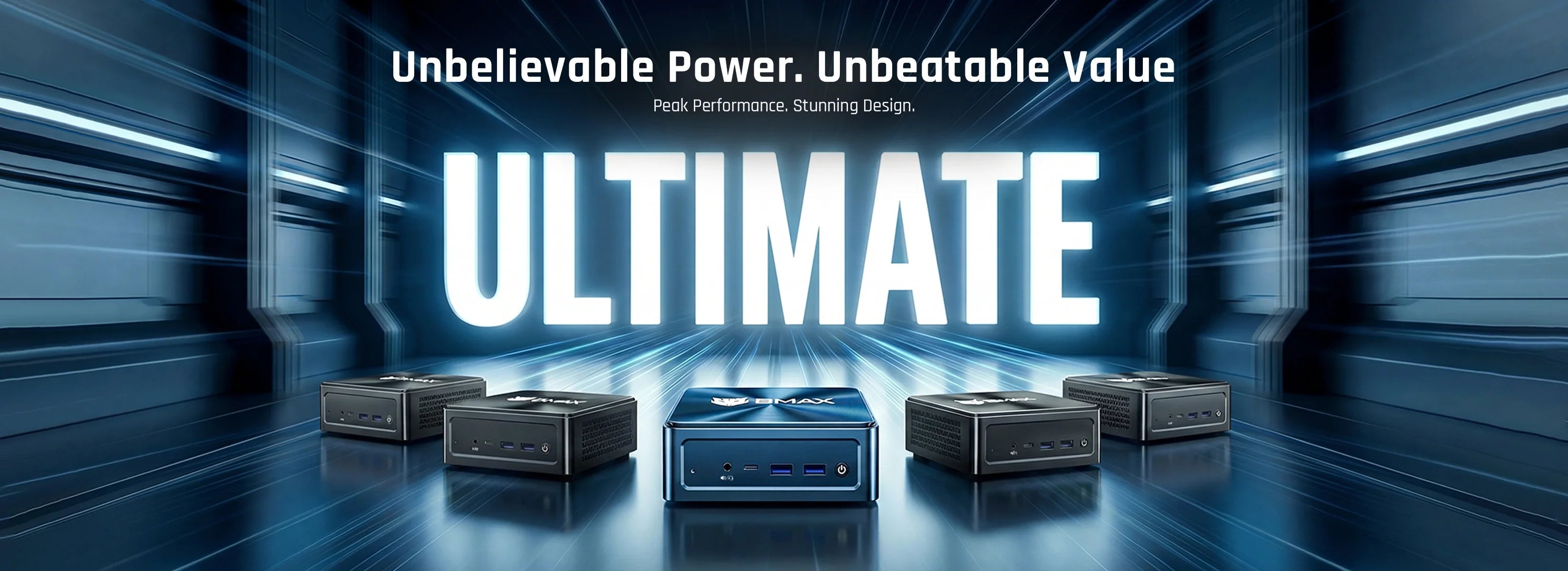
16GB / 512GB for $459.99. The BMAX B11 Pro matches the base Mac mini's memory and doubles its storage — with Windows 11 Pro and a drive you can replace.
Trademark notice: Mac mini and macOS are trademarks of Apple Inc. BMAX is not affiliated with, endorsed by, or sponsored by Apple. Product names are used only to identify the products being compared. Prices and specifications were accurate as of October 2026.
Sources
- Mac mini M6 and M5 Pro pricing, US: MacRumors, 25 August 2026 — M6 $899 (16GB / 256GB), M5 Pro $1,699 (24GB / 512GB); M4 re-priced to $799 in June 2026.
- Soldered NAND on M6 / M5 Pro: MacRumors, 22 September 2026.
- M6 performance and connectivity claims: Apple Newsroom, 25 August 2026.
- BMAX B11 Pro (16GB / 512GB, $459.99) and B12 Power (24GB / 1TB, $749.99): bmaxbuy.com product pages, October 2026.
- Electricity at 17.45 ¢/kWh: EIA Electric Power Monthly, January 2026 US residential average.
Prices are US list prices as of October 2026 and exclude tax. Mac mini power draw is modelled at 5W idle / 15W office work; BMAX figures are modelled at 12.4W / 27W (B12) and 8.6W / 19W (B11). Monitors, keyboards and mice excluded from every total.