In 2026, the personal computer industry stands at a peculiar crossroads: the overall market is contracting, yet structural opportunities are exploding.
Recent research reports from authoritative institutions predict that global PC shipments will fall from 297 million units in 2025 to 255 million in 2026—a 14% year-over-year decline. This adjustment is expected to persist through 2027, with true stabilization not occurring until 2028. Rising costs for memory and CPUs, combined with the fading "refresh cycle" boost triggered by the end of Windows 10 support, are collectively suppressing total industry volume.
Yet, the same reports express great optimism in other areas: global AI PC shipments are projected to rise to 150 million units in 2026—up 39% year-over-year—with their share of the total PC market surging to 59%. By 2028, AI PC penetration is expected to climb further to 82%, accounting for 84% of total revenue. IDC statistics corroborate this trajectory, showing 114 million AI PC shipments (43% penetration) in 2025, with the figure projected to surpass 55% in 2026.

This represents the most profound "divergence between volume and price" in the PC industry's forty-year history: while shipment volumes are shrinking, revenue is projected to dip by only 5% in 2026, and the average selling price is set to rise from $933 to $1,025. The AI PC is not merely a product line upgrade; it is rewriting the industry's growth formula—shifting the focus from "selling more units" to "delivering smarter devices at higher price points."
The PC's "Midlife Crisis" and the Rapid Iteration of AI Technology
Traditional PCs have evolved over four decades, yet their core form and logic have remained unchanged: screen, keyboard, and mouse; launching software and saving files. They have always been machines that simply "wait for instructions."
The paradox of the past two years lies here: while Large Language Models (LLMs) have demonstrated the ability to understand intent and generate content, these capabilities have largely remained confined to cloud servers, out of reach of the files, emails, and workflows that users handle daily. You can ask a large model a question, but it cannot help you transcribe last week's meeting recording into minutes, compare project schedules, or send reminder emails to colleagues—because it cannot access your local data or operate your software.

There is only one way to resolve this contradiction: embedding AI directly into the computer. This requires a systematic overhaul of chip architecture, operating systems, and software ecosystems, rather than simply adding an "AI button."
In recent years, chip giants like Intel, AMD, and MediaTek have crowded into the AI race, entering the core processor market for AI PCs and unveiling their respective on-device AI solutions almost simultaneously. This is no coincidence; it reflects an industry consensus: the AI PC represents the only growth avenue in a sluggish PC market.

A Threefold Transformation: What the AI PC Rewrites
Hardware Architecture: From "Division of Labor" to "Integration"
Traditional PC chips rely on a division of labor—the CPU handles general computing while the GPU manages graphics, with data constantly moving between them. However, AI models require simultaneous processing of massive amounts of data, making this data transfer a bottleneck.

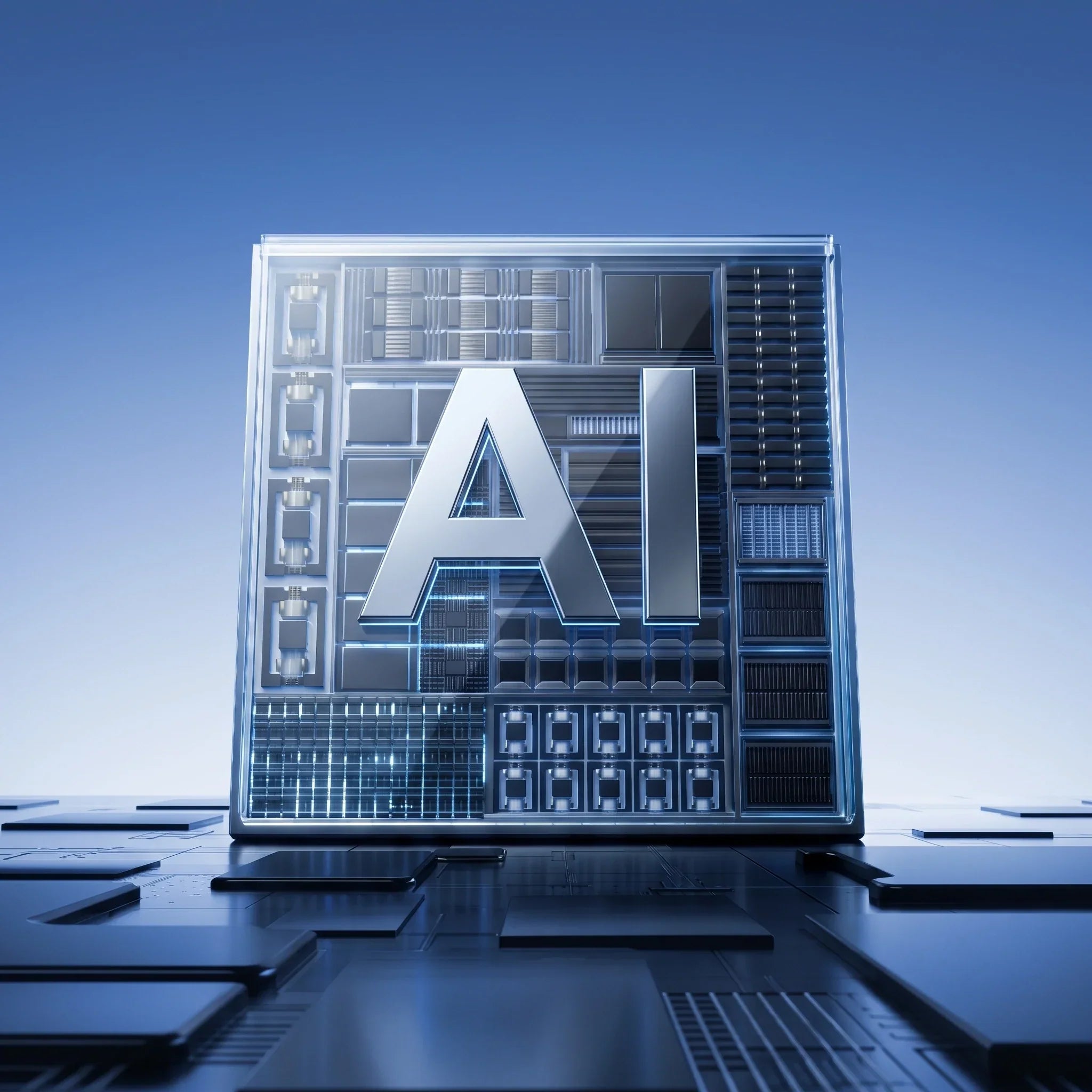
AI PC chips are moving toward integration: the CPU, GPU, and AI-specific computing modules (NPUs) are combined and share high-capacity memory, allowing AI models to reside permanently within the system. In other words, it gives the computer a "local brain."
Interaction: From "Manual Execution" to "Verbal Instructio
If AI can interpret the screen, understand speech, and grasp context, human-computer interaction shifts away from "clicking here" or "dragging there." Users simply need to tell the computer, "Extract the key points from this report, create a three-page PowerPoint presentation, and use that template from last time." The computer then handles the file retrieval, software launching, formatting, and generation. In this way, AI becomes a ubiquitous, system-level service.

Software Ecosystem: From "Standalone Software" to "Cross-Application Agents"
This is the most critical variable. Currently, using a computer essentially means using standalone applications—Word is Word, and Excel is Excel. The logic of the AI PC, however, is cross-application; an AI assistant needs to access documents, spreadsheets, emails, and calendars simultaneously to complete a comprehensive task. This shift is transforming how we define various aspects of the digital landscape: the PC is evolving from a mere tool into an employee's "digital workstation," while local computing centers are becoming a new line of defense for enterprise data security. "Cloud-edge synergy with an edge-first approach" is emerging as the new trend. In other words, cloud-based public large models are invoked only for processing general information flows, whereas scenarios requiring low latency, localization, or offline operation are handled by local PCs and workstations.

The Path of Transformation in the "Year of AI Agents"
The industry widely regards 2026 as the "Year One" of practical AI implementation—often referred to as the "Year of AI Agents." From an industrial perspective, the PC sector is undergoing a paradigm shift:
• Shift in growth logic: Moving from "selling more devices" to "increasing the value of each device."
• Shift in competitive logic: Moving from "price wars" to a dual-driver strategy of "high-end AI flagships" and "scenario-specific hit products."
• The shift in value chain logic: from "low-profit, high-volume sales like selling bottled water" to "value-added competition like specialty coffee".
• Shift in geopolitical and supply chain logic: The restructuring of AI PC hardware is leading to a rediscovery of the value within China's supply chain. Domestic chipmakers are achieving breakthroughs in key technologies, while upstream and downstream sectors—including system assembly, PCBs, storage, and thermal management—are benefiting simultaneously. The domestic supply chain faces a dual opportunity: import substitution and rapid market expansion.

The PC is facing a "midlife crisis," yet this very challenge offers an opportunity for renewed growth. Over the next three years, the keyword for the PC industry will not be "recovery," but "reconstruction"—reconstructing hardware architecture, interaction methods, software ecosystems, and the competitive landscape. Manufacturers capable of transforming AI from a mere "feature" into a core "product architecture" will win the future; conversely, players who simply slap an "AI" label on traditional PCs will eventually be swallowed by the wave of "shrinking volumes but rising prices."
For the first time in the PC industry's forty-year history, the protagonist of the story is neither a "faster CPU" nor a "lighter chassis," but rather "AI living inside the computer." This story is only just beginning.

As an innovative brand specializing in personalized digital products, BMAX adopted a forward-looking strategy early on to establish a comprehensive presence across sectors such as mini PCs, laptops, and tablets. Its recently launched AI PCs have won the favor of consumers in numerous countries and regions, thanks to their exceptional design, specifications, performance, and value for money. Most importantly, every product undergoes 300 rigorous quality control checks before leaving the factory and comes with a one-year warranty, ensuring reliable quality. When choosing an AI PC, choose BMAX!